
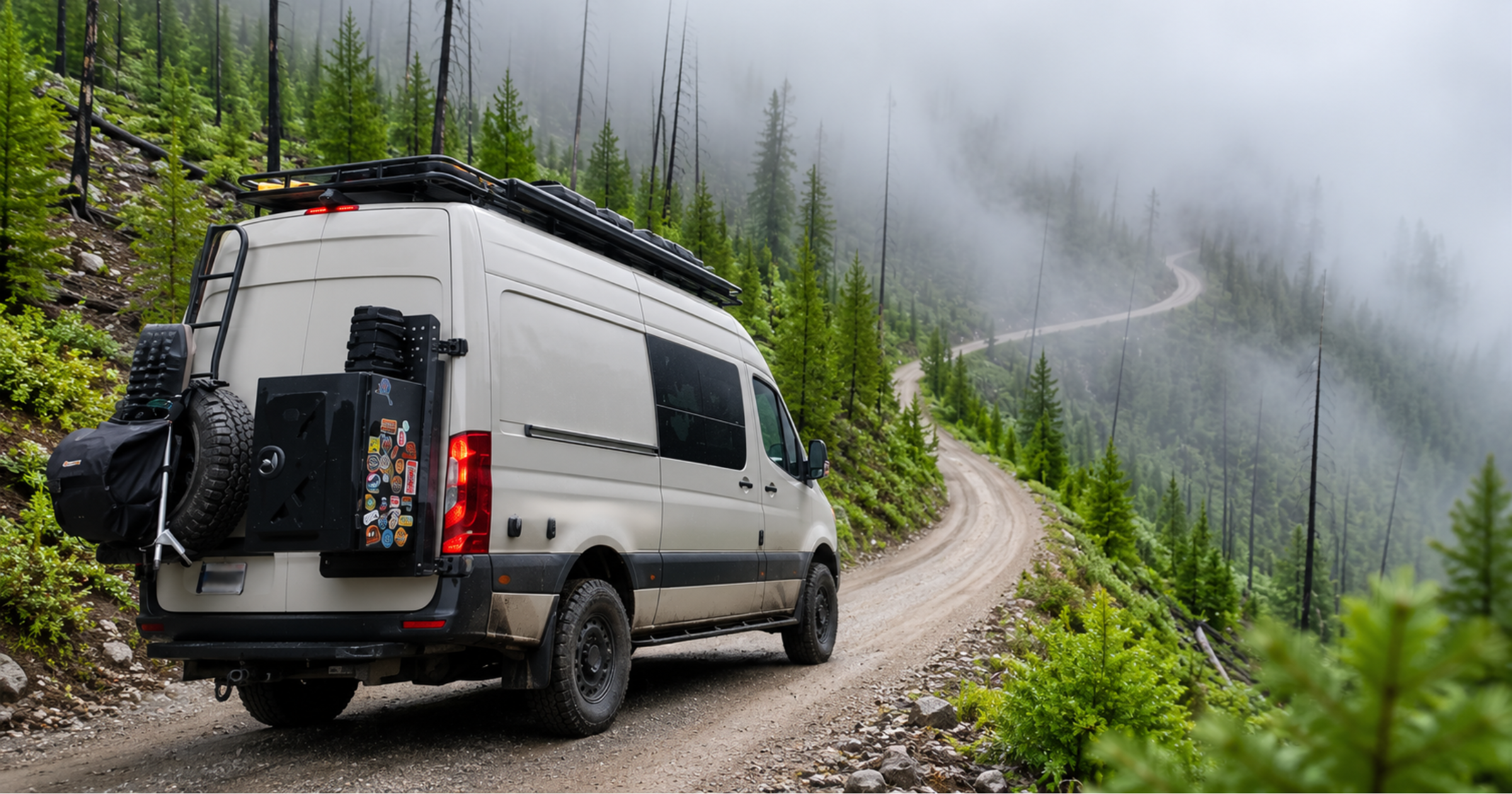
There’s something special about turning off the pavement and heading toward a place most people will never see.
Some of our favorite campsites, hikes, and memories have come from roads that you have to search really hard for. But remote roads also come with a different level of responsibility. You’re out there on your own and have to be self-reliant to prevent tricky situations from becoming major catastrophes.
We were reminded of that recently while attempting to drive Idaho’s Magruder Corridor. We checked the forecast before leaving, expecting a little rain. Instead, we found ourselves navigating a snowstorm on a narrow mountain road with steep drop-offs and deep snowdrifts blocking our path. Eventually, we had to make the difficult decision to turn around.
The experience reinforced something we’ve learned over two years of full-time van life:
Preparation isn’t about expecting the worst. It’s about giving yourself the tools to make good decisions when things don’t go according to plan.
These are the ten items that have earned a permanent place in our van before we head down any remote road.
AFFILIATE DISCLAIMER: Some of the links below are affiliate links. If you choose to use them, we may earn a small commission at no extra cost to you. We only recommend products we use ourselves and love. This helps keep us on the road and making content. We appreciate your support!
1. A Reliable Dash Camera System
If we had to choose one upgrade that’s made driving our van noticeably less stressful, it would be our WOLFBOX G900 Pro.
Unlike a traditional rearview mirror, it gives us a wide-angle, unobstructed view behind the van, even though we don’t have back windows. That’s incredibly valuable while navigating tight forest roads, backing into campsites, or squeezing past obstacles.
During our Magruder Corridor attempt, the rear camera became one of the most important tools in the van. As we carefully backed down a narrow shelf road in the snow, it gave us a much clearer view of what was behind us than mirrors alone ever could.
We originally installed it because we wanted a better mirror.
Now, we wouldn’t want to tackle remote roads without it.
👉 We’ve been using the WOLFBOX G900 Pro for months now, and it’s one of those products that has genuinely earned a permanent place in our van. You can check it out here.


2. Offline Maps
Cell service disappears surprisingly quickly once you leave the highway.
Before heading into the backcountry, we always download offline maps and save our route in multiple apps. One of our favorite apps to use is onX. This powerful app allows you to download off-road trails, create waypoints and your own route, share with others, and read recent reviews.
In addition to onX, we’d also recommend downloading a secondary app like Gaia GPS. We love Gaia for confirming where public lands are, elevation and terrain, and established roads.
Having several offline navigation options has saved us more than once.
3. A Tire Repair Kit & Compressor
Flat tires happen. Over the course of two years traveling full-time, we’ve had two flats in places we’re so glad that we had a tire repair kit and compressor. One was on the Dempster Highway in the Yukon, and the other was on a very remote backroad in Utah.
Being able to plug a tire and reinflate it yourself can turn what could have become an overnight emergency into a 20-minute inconvenience.
We personally love our Rhino USA Tire Repair Kit and won’t travel a dirt road (or any road for that matter) without it.

4. A Recovery Kit
Multiple pieces of gear make up our recovery kit, but as a whole, it’s something essential for anyone off-roading. Not only have we used it for ourselves, but we’ve also used it to help others in need.
Our basic recovery kit includes:
For our full write-up on recovery gear essentials, read our other blog post here.
5. Extra Food & Water
Remote roads rarely go exactly according to schedule. A road closure, mechanical issue, or unexpected weather can quickly turn a day trip into an overnight stay. By nature, they always take longer than expected.
We always carry extra food and more water than we think we’ll need. That usually includes a couple of backup frozen meals or cans of soup and making sure that our water tanks are topped off.
Just yesterday, we were on a remote road in Montana and were able to refill water bottles for a bicyclist who had run dry.
We especially love having our ICECO APL35 for extra food in the van. It really helps us carry enough supplies for a full week, while still eating fresh food.

6. First Aid Kit
When you work and play in the elements, they sometimes push back.
Cuts, burns, twisted ankles, and splinters all become much bigger inconveniences when you’re hours from the nearest town.
Having the right supplies means you can handle small problems before they become bigger ones.
Our go-to first aid kit is one that is small, but powerful. It takes up virtually no space in the van and also comes along with us in our backpacks on hikes.

7. A Satellite Communicator
One of the hardest things about traveling remote roads is accepting that your phone simply won’t work.
With advancements in technology, Starlink gives us the ability to reach emergency services or let family know we’re okay, even when there’s zero cell coverage. During wildfire season or when weather is on the horizon, it also allows us to check conditions so we can make the best decision based on the information available.
Thankfully, we’ve never needed it for an emergency, but we still wouldn’t leave without it.
8. Recovery Saw
When we set out for our summer travels this year, we expected mud and some fallen trees, but we had no idea just how bad the blowdowns would be. The states we’re currently traveling through (Idaho and Montana, in particular) received record winds over the winter, and trees on trails have turned us around not once, but twice.
Although we’ve had our share of failed trail attempts, without our hand saw, we would have had to turn around way more times.
We picked up this Fiskars hand saw at a hardware store and are so glad we have it in the van. It also works great for harvesting small pieces of firewood.
PS – We’ll be bringing extra muscle next summer with a chainsaw.

9. Extra Fuel
You might never think it is going to happen to you, but when you have to unexpectedly turn around or make a long detour, that full tank of fuel you had can hit empty pretty quickly. Additionally, you tend to burn fuel a lot faster than you would think when you’re off-roading.
We found ourselves in one of these situations recently on the Idaho Backcountry Discovery Route. We had plenty of fuel to make it from point A to point B, but after we had to unexpectedly turn around due to downed trees, it added a lot more mileage than we had expected.
Thankfully, we had our Rotopax fuel canisters and were able to put four extra gallons in the tank. It may not seem like a lot, but that’s around 40 additional miles that we didn’t have before. After that scare, we’ll always make sure that they’re full anytime we start an off-road trail.

10. A Flexible Mindset
While this isn’t something to physically pack in your rig, it might be the most important item on the list.
One of the biggest lessons we’ve learned over two years of living on the road is that not every destination is worth forcing. Sometimes turning around is the safest and smartest decision you can make. It’s a hard pill to swallow, but the best in the long run.
If we ever feel that our personal safety is at risk, we make the call and find a place to turn the van around. The mountains will still be there next time.
Final Thoughts
One of the reasons we love exploring remote roads is because they continually remind us that adventure isn’t about checking destinations off a list.
It’s about adapting. Learning. Making good decisions. And appreciating just how wild these places still are.
We live in a world where a lot of places feel like they have become overrun, but if you look hard enough, you can still find remote corners.
If you’re planning to explore remote backroads yourself, we hope this list helps you feel a little more prepared for wherever the road leads.
Safe travels, and we’ll see you out there.
Watch the Adventure
Want to see why these items matter?
Watch what happened when we attempted Idaho’s legendary Magruder Corridor and unexpectedly found ourselves driving through a summer snowstorm.
📺 Watch the video here:
Leave a Reply